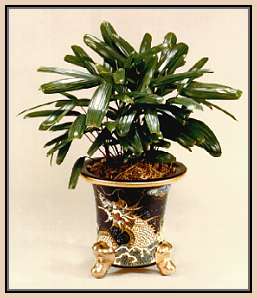
| Uniquely, Rhapis excelsa is the only ornamental palm species with named green and variegated varieties, each having a distinctive leaf shape and growth habit. A selection of these miniature cultivars provides an exciting choice of exotic shapes and textures which are almost unlimited. |
|
|
|
The named varieties shown below are all produced from divisions and are at least 4 years old. Generally, those in 4" pots are single cane 12" to 16" in height, depending on variety; those in 5" pots have 2 or more canes and are 14" to 18" tall from bottom of pot to top of leaves. Periodically, we have larger ones with multiple canes in 6" to 14" pots
up to 48" in height.
|
![]() |
'KOBAN', the most popular variety, has wide leaf segments, a medium growth rate, and a full spreading growth habit. Besides being "distinctively different", this easy-to-grow Rhapis is an excellent interior palm. |
![]() |
'DARUMA' is a classic cultivar with leaves resembling the large "standard"
Rhapis excelsa. It has a medium growth rate and a tall, upright shape.
This variety is a favorite of those who prefer narrow leaf segments and
the traditional look of Lady Palms.
|
![]() |
'TENZAN', an extremely unusual Lady Palm, has long curving leaves and an elegant slender form. A fast grower, it is the tallest of all named varieties. One word says it all -- dramatic! |
![]() |
'KODARUMA', the ultimate mini-palm, is the shortest of all Rhapis. This slow grower puts a lot of energy into producing pups, so it grows "out" more than "up'. Small leaves on miniature canes personifies the word "dwarf". Irresistible! |
|
Only a few "Limited Editions" are produced each year from a small number of mother plants. |
![]() |
FUKUJU is a graceful Lady with narrow leaf segments and a slender growth habit. The variegated KOTOBUKI is a sport of this lovely green variety. |
![]() |
This variety is very rare and quite different from the others. It has big thick canes and large blue-green leaves. A tall very sturdy, fast grower. |
![]() |
Considered the "King" of Rhapis palms, it has enormous leaves (compare to Daikokuten above) and the thickest stalk of any variety. |
![]() |
Nanahowaden is from the same group as Heiwaden (considered the Queen of Rhapis) and Towaden with leaves that seldom split. Nanahowden has long, soft wide leaves which give a very graceful appearence. This is the first time we've offered it because of rarity and scarceness. Click HERE to see a larger photo of the one at right and others we have available. |
![]() |
This 52 page reference to all types of "Lady Palms" contains the 300 year old history of Rhapis, complete culture and care, plus bonsai suggestions. Numerous color photographs, illustrations, and charts are included. Click on the book to read more about it. |
| Dwarf Rhapis excelsa are a delight. Treat
yourself to one or to several and start a collection. You will find that
each Lady has an elegant and unique personality all her own.
|
|
|



