| The relentless August sun inched its way toward the
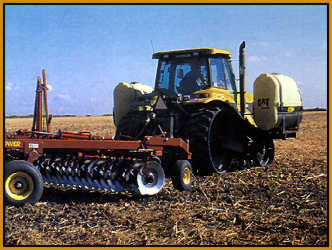
100 degree mark as Raymond Rodriguez turned the McKamey Farms' Challenger
85C tractor back along the mile-long trek to the highway. Raymond
was pulling a 20-foot rigid shank chisel plow, running about 16 inches
deep. A few weeks ago, this field yielded an excellent grain sorghum
crop. Now it was time to begin preparation for next year.
|
||||||||||
|
||||||||||
| "Dry land farming" is what they call it here on the Texas coastal bend
just north of Corpus Christi. The technique entails loosening up
the soil as much as possible above a 36-inch deep clay layer, so that the
land becomes like a sponge, absorbing and holding as much moisture from
fall and winter rains as possible.
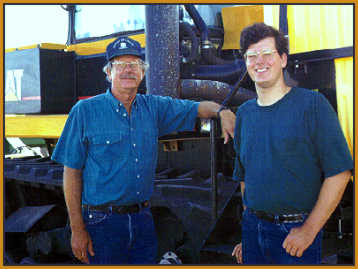
From planting time until harvest, farmers are totally reliant on sporadic spring and summer showers for needed interim moisture, and are hopeful that hurricanes entering the Gulf of Mexico will steer clear of them. Once the harvests are in, September and October storms are generally welcome, starting the moisture build up for the following year. Kenneth McKamey's family has been farming this area since the turn of the century when his great grandfather, an insurance salesman by trade, visited the Corpus Christi area. He liked what he saw and established the McKamey family farm near Taft, about 20 miles north of the city. Kenneth received an abrupt introduction to farm management when his father died suddenly in 1968. "I was in the Army, stationed at Fort Hood at the time. Since there was no one else to take over, I was given a hardship discharge and called back home. About the same time, our farm manager decided to call it quits, and I found myself in an urgent on-the-job training program." McKamey Farms grows grain sorghum and cotton on some 4000 acres here, 1000 of which are leased. They also operate a major cotton gin and grain elevator. "My gin manager came down with pneumonia and died a year after Dad passed away," recalls Kenneth. Needless to say, he had his hands full. His first move was to lure Richard frost, an old Army buddy, as farm
manager. "Richard grew up on a farm in Minnesota," according to Kenneth.
"He knew farming, but nothing about cotton or hurricanes. The first
year, I was back at Fort Hood on summer reserve training. Richard
calls to tell me the wind is blowing 200 miles an hour, and it doesn't
took like the rain will ever stop. He was looking for advice, and
I'm afraid I wasn't much help." Twenty-eight years later, Richard continues
to manage the farm, and Kenneth's on-the-job training program, hurricanes
notwithstanding, has obviously been a ringing success.
Over the years, McKamey Farms has used a variety of agricultural tractor brands and models. "Caterpillar has been trying to sell me ag tractors for over 20 years," says Kenneth. "Quite a few of the steel-tracked special application machines were sold in this area back in the 70's. I would have had a problem getting them across a paved road, so I never bought one. Then when the rubber-belted tillage models came out in the mid 80's, I wasn't particularly interested because most of my applications were row crop. Two years ago, I saw a Cat Challenger 45 at a farm show in Corpus Christi, and asked to have it demonstrated on the farm."
Next to drought, compaction is probably the worst enemy of this type of farming. As Kenneth puts it, "Compaction destroys the soil surface, lessening the land's ability to retain moisture and oxygen. With our dry land farming down here, keeping that moisture available is critical. The concept of reducing compaction made a lot of sense to me. We could tell right away from the footprint left by the Challenger tractor that it was not compacting the soil like our rubber-tired tractors. We've had the Challenger 45 tractor two years now, and have been very pleased with the difference it has made."
Another factor is the trend toward flat farming. "I really prefer beds, insists Kenneth. "They keep the plants out of the water when it's too wet, and provide deeper moisture availability during dry spells." But flat farming is less labor-intensive, and labor is getting harder to find and more costly. Without beds, minimizing compaction becomes even more critical. "In a dry year, flat farming can be the pits," he emphasizes. Going to flat beds provided the incentive to purchase a Challenger 85C tillage tractor last year. While minimizing compaction was its main selling point, the McKameys have also found this machine able to plow deeper than their rubber-tired tractors - an extra bonus to improving moisture retention. This year was the first year in a while that too much rain threatened
to cross up the planting schedule. Because of the threat of compaction,
Kenneth says he'll do almost anything to keep from going into his fields
when they're wet. The Cat rubber-belted tractor does give him the
option of doing so if he's way behind schedule and has no other choice.
"The Challenger tractors have better traction than my other brands," according to the elder McKamey partner. The Cat machine has a radar gun net connected to a digital readout on the dash showing the slippage you're experiencing. Some of our other tractors have similar gauges, so we know the Challenger tractor is getting more pulling power to our implements. Actually, you can see the difference in traction when the tractors are working side-by-side." When comparing power between Cat tracked tractors and others, McKamey
figures a good rule of thumb is that the Challenger tractors have pulling
power equivalent to rubber-tired tractors with 25 percent more horsepower.
In other words, their Challenger 45 with 200 hp performs the same work
as a 250 hp rubber-tired tractor.
"I know my people appreciate the smoother ride of the Challenger tractors," says Kenneth. "When we cultivate across a bedded field, we like to go diagonally. Under those conditions, a rubber-tired tractor will rattle your teeth. You really have to be careful. The rubber-belted Cat tractors smooth over those bumps and allow the operator to concentrate on what he's supposed to be doing." Bill Smith, who was operating the Challenger 45, commented on the comfort of the tractor: "I can't imagine being in a rubber-tired tractor for the 12-hour shifts we're running now. I'd be so tired, I wouldn't be able to do anything the rest of the day. This Challenger 45 is the most comfortable tractor I've ever operated." Farm Manager, Richard Frost, reported he's experiencing a 30 percent fuel efficiency improvement from the Challenger tractors over his rubber tired machines. He uses the Challenger 45 tractor to pull several implements, including a 38-foot field cultivator, a hooded sprayer and a 40-foot rotary hoe. Fertilizer and herbicide incorporation are handled by both tractors, the Challenger 45 being set up with two 250-gallon saddle tanks, while the Challenger 85C is equipped with 300-gallon tanks. Besides the 20-foot chisel plow, the 85C is also used to pull a 52-foot field cultivator and a 40-foot field plow with 18-inchsweeps. The McKameys use 30-inch belts on the Challenger 85C and both 18 and 24-inch belts on the Challenger 45. Kenneth McKamey says he's seeing more and more of Cat's tracked ag tractors on farms in this area. Many of his neighbors apparently are coming to realize the benefits of battling compaction. As Richard Frost says, "If you walked blindfolded out in a field
worked by both rubber-tired and tracked tractors, you'd know where each
had been working. The difference is startling."
FARMING ON TRACK
For more information, contact HOLT CAT at (800) 275-4658 or visit their
web site.
|
||||||||||
 |
||||||||||
|
All Text and Graphics Copyright © 1997 by Holt Company of Texas unless otherwise specified.  |